Sign-supported communication
Shortly after the United Nations Convention on the Rights of Persons with Disabilities came into force in Germany in 2009, according to which the participation of people with disabilities in all areas of life is a human right, the "Die Wichtel" daycare center accepted its first baby with Down syndrome into one of its regular daycare groups - as one of the first in Heidelberg.
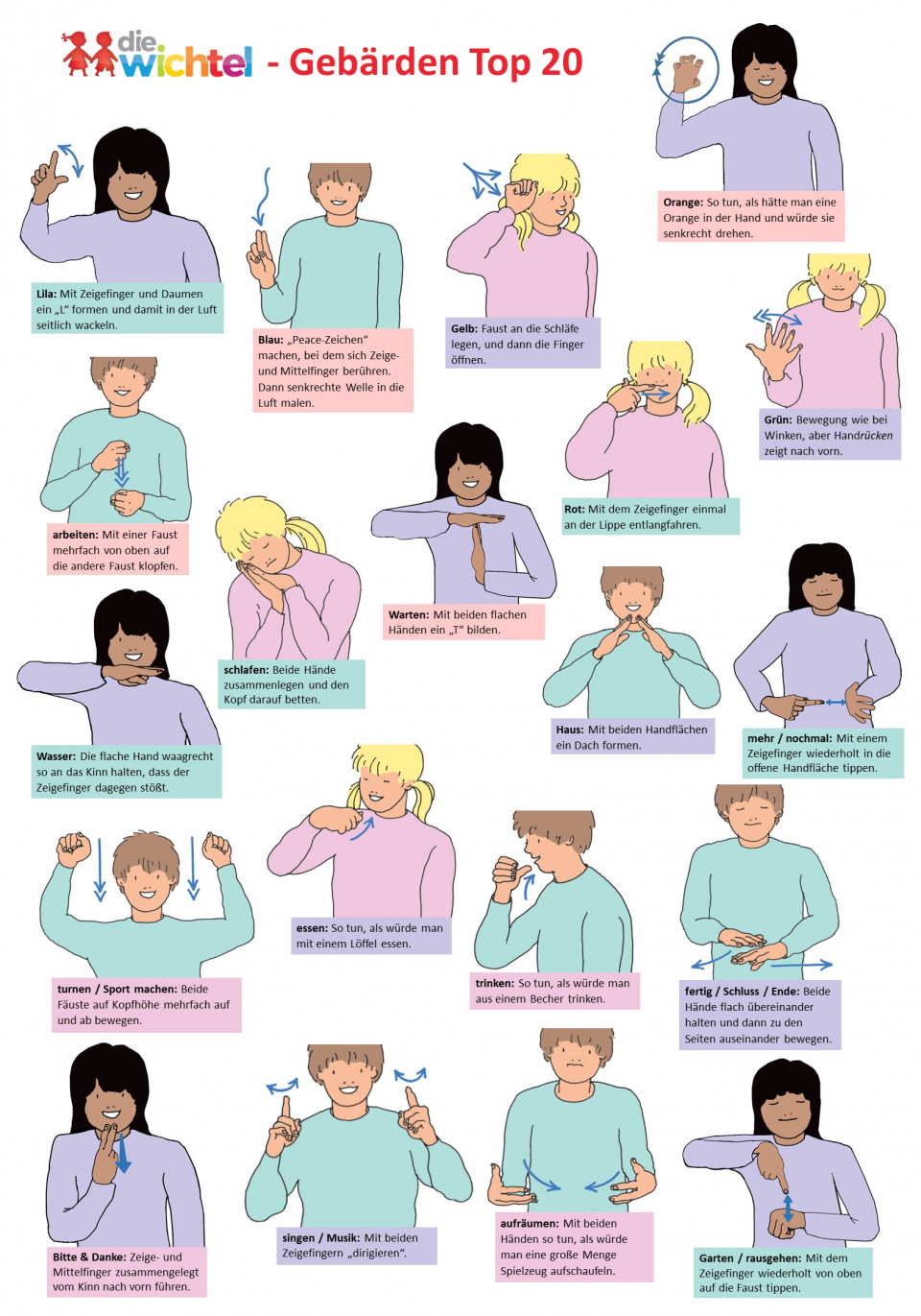
To promote his language development, the nursery teachers began to familiarize themselves with the "sign-supported communication" (GuK) system developed by Prof. Etta Wilken. Little by little, the sign vocabulary was expanded so that our children with Down's syndrome, who now number several, were finally able to use numerous signs to communicate with each other when this was not yet possible verbally due to their slower language development.
To promote his language development, the nursery teachers began to familiarize themselves with the "sign-supported communication" (GuK) system developed by Prof. Etta Wilken. Little by little, the sign vocabulary was expanded so that our children with Down's syndrome, who now number several, were finally able to use numerous signs to communicate with each other when this was not yet possible verbally due to their slower language development.
As the research situation shows a clear benefit with regard to the use of gestures for all children (with and without disabilities) at a pre-linguistic age, a small basic stock of gestures has now been firmly established in all crèche groups.
In the kindergarten groups, all children and teachers have a sign for their own name. A photo wall in the hallway clearly shows everyone how natural these name signs are. There are photo books with various sign language cards, and at the joint summer party across the daycare center, a song with sign language accompaniment is always sung to match the annual motto.
In the USA, so-called "baby signs" have been widely used since the 1980s; this trend has now also arrived in Germany. There are numerous sign systems whose signs are similar, but not all are 100% congruent. We mainly work with the signs according to Prof. Etta Wilken's GuK system as well as with "Schau doch meine Hände an" (Bundesverband evangelischer Behindertenhilfe, www.beb-ev.de ) and Spreadthesign (https://www.spreadthesign.com/), which contains signs from various sign languages around the world. If necessary, we also come up with our own signs, e.g. for the individual names of the children and teachers. We make a selection of signs available to the parents of our facility.
In the kindergarten groups, all children and teachers have a sign for their own name. A photo wall in the hallway clearly shows everyone how natural these name signs are. There are photo books with various sign language cards, and at the joint summer party across the daycare center, a song with sign language accompaniment is always sung to match the annual motto.
In the USA, so-called "baby signs" have been widely used since the 1980s; this trend has now also arrived in Germany. There are numerous sign systems whose signs are similar, but not all are 100% congruent. We mainly work with the signs according to Prof. Etta Wilken's GuK system as well as with "Schau doch meine Hände an" (Bundesverband evangelischer Behindertenhilfe, www.beb-ev.de ) and Spreadthesign (https://www.spreadthesign.com/), which contains signs from various sign languages around the world. If necessary, we also come up with our own signs, e.g. for the individual names of the children and teachers. We make a selection of signs available to the parents of our facility.
GuK is the abbreviation for sign-supported communication and was developed by Prof. Etta Wilken for children who are not yet able to speak. The accompanying use of gestures makes it easier for them to communicate. It does not replace speech (as is the case with German Sign Language, for example), but only supports it with gestures. Also, not all words are signed, but only the meaningful elements of a statement parallel to spoken language (e.g. "We are going to get dressed and go to the garden.").
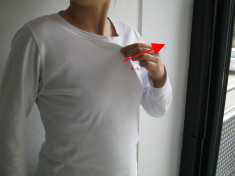
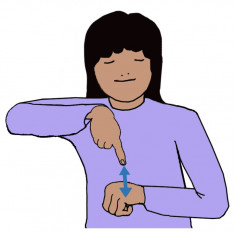
As it is easier to sign than to speak (signing is less demanding on a child's motor skills than the complex articulation processes of spoken language), by learning to sign, children acquire the ability to communicate with their environment in line with their more developed cognitive skills. In our experience, all children of nursery age benefit from sign language, as they can communicate their wishes or observations. This reduces the frustration of not being understood by the environment. At the same time, the children enjoy interacting and communicating with others. In this way, GuK supports understanding and communication and promotes learning to speak and cognitive development, e.g. by providing clear categories:
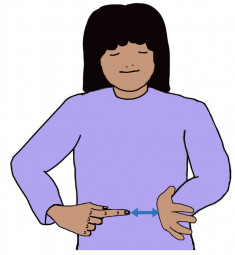
The sign for "finished" is used for all kinds of action endings, e.g. the end of a meal ("Are you finished eating?"), the end of looking at a picture book ("Now the book is finished and we're going to bed") or the request to stop whining ("I want you to stop now.").
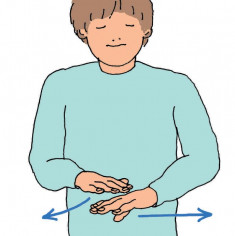
The gesture for "more" is used to indicate quantities and also for desired repetitions of actions (e.g. "Would you like to eat more pasta?", "Would you like to slide again?").
In addition, phonetically similar words (e.g. at home - at break, table - fish) are easier for children to distinguish visually using gestures, which can train their auditory discrimination skills.
The sign-supported communication we use in the daycare center is therefore NOT a language in its own right, such as German Sign Language. Rather, SAC acts as a bridge for the time when children are not yet able to speak verbally, but can already cognitively grasp and comment on a great deal of their environment. Experience shows that children generally use sign language until they can communicate sufficiently well using words.
In addition, phonetically similar words (e.g. at home - at break, table - fish) are easier for children to distinguish visually using gestures, which can train their auditory discrimination skills.
The sign-supported communication we use in the daycare center is therefore NOT a language in its own right, such as German Sign Language. Rather, SAC acts as a bridge for the time when children are not yet able to speak verbally, but can already cognitively grasp and comment on a great deal of their environment. Experience shows that children generally use sign language until they can communicate sufficiently well using words.
For children who are growing up multilingual, gestures represent a bridge between the different languages - the gesture for the German "Gelb", for example, also applies to the English "yellow", i.e. the gesture facilitates the understanding of the meaning behind a word and thus the acquisition of multilingualism.
In recent years, we have found that all the children are very interested in the signs and ask for different signs for new words on their own initiative or even develop their own ideas for words for which we do not yet have fixed signs (e.g. for the dumplings that we sometimes eat for lunch). Signs are also a practical "secret language" that we can use to communicate, for example, when we are standing far apart in the garden or want to talk across a window between two rooms. We also accompany selected songs or rhymes with sign language and have provided all the weekly plans displayed in the daycare rooms with the sign language for the days of the week. For all children, the signs have the character of "finger games", which are generally very popular at this age.
In recent years, we have found that all the children are very interested in the signs and ask for different signs for new words on their own initiative or even develop their own ideas for words for which we do not yet have fixed signs (e.g. for the dumplings that we sometimes eat for lunch). Signs are also a practical "secret language" that we can use to communicate, for example, when we are standing far apart in the garden or want to talk across a window between two rooms. We also accompany selected songs or rhymes with sign language and have provided all the weekly plans displayed in the daycare rooms with the sign language for the days of the week. For all children, the signs have the character of "finger games", which are generally very popular at this age.
Language acquisition is NOT delayed by the use of gesture-supported communication, but rather facilitated because 1. the gestures usually look very similar to what they stand for and are therefore easier for the child to remember than (invisible) words, 2. the execution of gestures places less motor demands on the child than the complex articulation processes of spoken language and 3. the adult not only demonstrates the gestures to the child, but can also guide the child's hands if necessary. The use of gestures can therefore be regarded as a preliminary stage of speech, just as crawling is a preliminary stage of walking.
Further information and ordering options for the materials can be found at
https://www.ds-infocenter.de/html/guk.html and at
http://schau-doch-meine-haende-an.de and
https://www.spreadthesign.com/
{INCLUSION_NAVI}