concept
The concept is aimed at parents and educational staff at the "Die Wichtel" daycare center and describes the current framework for educational work. At the same time, it serves as a basis for further development and reflection.
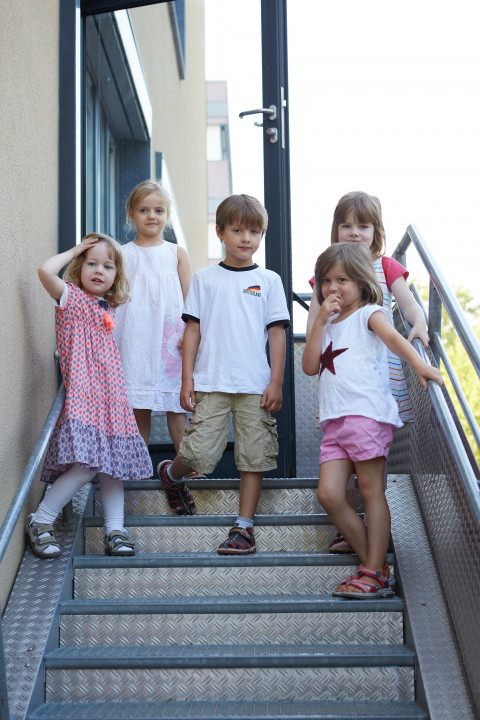
As a childcare facility, we work to complement families and promote the overall development of children from the age of 6 months until they start school. Our facility is run by the "Beruf und Kind" association, which originally grew out of a parents' initiative.
Working parents, their children, and their needs are particularly close to our hearts, and we have made it our mission to support parents in better balancing work and childcare.
Educational mission and goal of the work at the facility
Our educational, teaching, and care mission includes holistic support, i.e., a focus on children's cognitive, emotional, social, motor, linguistic, sensory, and moral development. In fulfilling our duty of care, we focus on children's rights, which are enshrined in the UN Convention on the Rights of the Child and §8a (4) SGB VIII.
A broad educational foundation, as specified in the "Orientation Plan for Education and Care in Day Care Facilities for Children in Baden-Württemberg," makes it easier for children to approach the new knowledge society with their whole personality. We want to make use of multicultural influences and thus help children develop an open world view.
Early childhood education and care includes guiding children toward developing personal, social, factual, and learning skills. Education begins with the child itself and is understood as a construction process in which the child actively explores its world through social interaction. Reliable relationships and bonds are a fundamental prerequisite for successful learning. Children have the ability to filter out important learning content from everyday situations and acquire it. We want to actively support these abilities by closely linking play and learning in our programs and projects. The "head, heart, hand" method helps us to do this, as it promotes learning through positive emotions and "understanding" the learning content.
Education, on the other hand, involves stimulating and challenging children as well as supporting and accompanying them in their educational processes. Our goal is to raise children to become independent, self-determined, and socially competent individuals. In doing so, we place particular emphasis on the development of autonomy and connectedness.
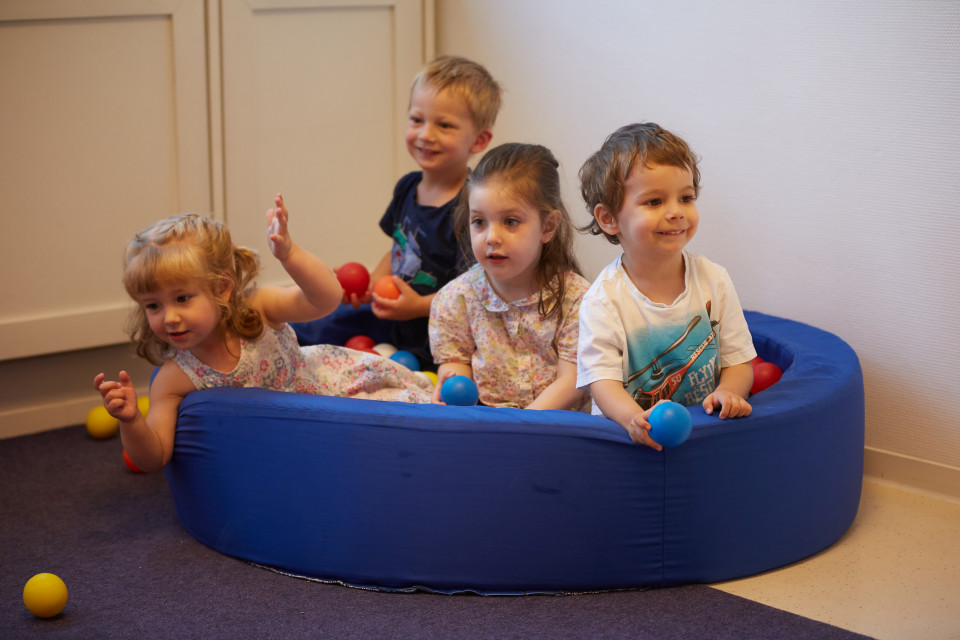
Connectedness and community spirit are also central aspects of our educational work. Children should experience attachment and belonging and be willing to actively participate in social interaction and take on responsibility. This can be achieved, for example, through group projects or joint games. We also encourage interest in others by giving children the opportunity to develop and maintain friendships. In this context, they learn to understand the thoughts, feelings, and actions of others, which forms the basis for respectful and empathetic interaction.
Our understanding of education and upbringing is based on a holistic approach that takes into account both the individual needs of the child and their active participation in the learning process.
The individual support of children is a central component of our concept. This is based on the age, developmental stage, abilities, and life situation of each individual child. We pay particular attention to the interests and needs of each child in order to ensure the best possible support. Our resource-oriented approach focuses on the individual strengths and abilities of the children as a starting point for specific activities and the design of the play and learning environment.
An excellent staff-to-child ratio enables us to respond intensively to the children's needs and support them individually. Continuous observation and documentation of their development forms the basis of our work and helps us to track the children's progress and support them in their development in the best possible way.
Our concept is embedded in the annual cycle, and the children are introduced to seasonal celebrations and events. Each of our educational staff members has a special area of expertise in which they continuously pursue further training. The children benefit directly from the resulting project work or special activities.
Starting nursery or kindergarten – according to the Berlin settling-in model
A child's transition to daycare represents a significant turning point that introduces a multitude of changes in the child's life. During this phase, the focus is on interaction between the family and the facility, with an emphasis on integration into the new living environment. Starting daycare represents a new beginning that must be carefully planned to ensure the child's well-being.
A gentle settling-in process, carried out in close cooperation with the parents, forms the basis for the child's successful adaptation to the new environment.
In order to make the transition from the family environment to daycare as smooth as possible, it is essential that a parent or other familiar caregiver accompanies the settling-in process. The presence of this caregiver, who represents a "secure base" for the child, encourages the child's openness and curiosity towards the new environment. This caregiver takes on the role of providing security and trust for the child, which is essential for the child's emotional well-being. Throughout the settling-in phase, the caregiver acts as a source of security, familiarity, and comfort.
A smooth and harmonious transition into everyday life at the daycare center can be facilitated by applying the so-called "Berlin settling-in model."
The duration of the settling-in process varies; typically, it takes between six and fourteen days to establish a stable relationship, but in some cases it can take several weeks. The specific length of the settling-in period is determined by taking into account the individual behavior of the child and is agreed upon in consultation with the group leader, the caregiver, and the parents.
As a rule, the settling-in process is quicker for kindergarten children, but the duration should always be adapted to the individual needs and behavior of the child.
Development observation and documentation
Education and learning stories
The concept of "education and learning stories" is based on the "learning stories" developed in New Zealand by Margaret Carr (2001). The aim of learning stories is to observe and describe children's learning and, based on this, to support and encourage them. Through observation and documentation, the child, parents, and educational professionals gain detailed insight into the child's individual learning and developmental steps.
The learning stories are based on the child's resources, i.e., the starting point for supporting the child lies in their strengths and interests, not in their weaknesses ("Strengthen strengths to weaken weaknesses"). The analysis of a child's learning is based on so-called "learning dispositions," which express a child's motivation and ability to deal with new situations or challenges. Learning dispositions are fundamental prerequisites for learning and educational processes and thus form the foundation for lifelong learning.
According to Margaret Carr, there are five different learning dispositions that an educator can observe and identify in a learning child:
- Being interested: The child shows interest in something and turns their attention to it.
- Being engaged: The child is willing to get involved in something and is absorbed in what they are doing.
- Perseverance in the face of challenges and difficulties: The child has the ability to continue their activity even when they encounter difficulties and obstacles, and develops problem-solving strategies.
- Expressing and communicating: The child interacts with others and communicates their ideas, feelings, desires, and interests (verbally and nonverbally).
- Participating in a learning community and taking responsibility: The child shows a willingness to see things from a different point of view and to develop a sense of justice and injustice. The child can make decisions and provide information about themselves, as well as develop strategies in exchange with others.
Ideally, after a certain period of time, all educational specialists in a group discuss their observations and look for a "common thread" that runs through all of them. They consider the next steps in how the child can be further supported in their interests and learning process and where there may be points of connection with the interests of other children in the group.
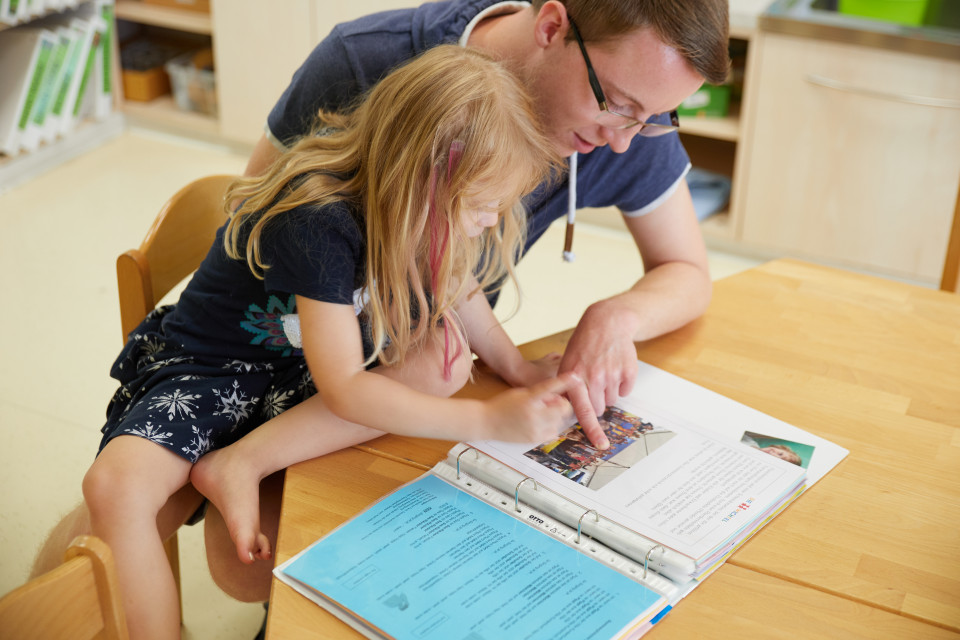
From time to time, the observation and support process based on Margaret Carr's concept results in a learning story that summarizes the child's learning process. This learning story is then read together with the child and filed in their portfolio.
This gives the child a sense of appreciation, attention, and recognition for their learning processes. Gradually, they gain insight into the strategies they use to pursue their interests and how they learn. This enables the child to become aware of their own learning processes and progress, as well as their learning strategies, and to build on these when learning new skills.
Biko diagnostics
Diagnostics for the Wichteln in the Yellow, Green, and Red kindergarten groups
The framework plan for elementary education for three- to six-year-olds stipulates that educational professionals systematically observe and document the educational processes of all children. The BIKO screening enables educators to determine whether three- to six-year-olds are developing appropriately for their age in key areas or whether they need additional support. The aim is to identify developmental risks at an early stage so that any delays can be compensated for through timely support before the child starts school. In order to strengthen early support, the city of Heidelberg introduced the "BIKO screening for the development of basic skills for 3- to 6-year-olds" in 2014, which arose from the projects "Quality Assurance in Heidelberg" (QUASI, Heidelberg University of Education) and "Organizing Education in Kindergarten" (BIKO, University of Münster). It provides scientifically evaluated diagnostic materials for daycare facilities.
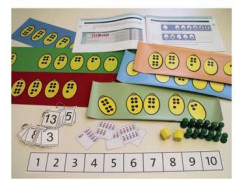
The inventory covers four areas of development: basic language skills, basic numeracy skills, motor coordination, and basic socio-emotional skills. With the exception of the procedure for the socio-emotional development area, all procedures are based on implementation tasks.
These are carried out in the form of individual examinations with a specially trained, familiar specialist working with the children in the daycare center. The questionnaire on basic socio-emotional skills is completed jointly by the specialists in the child's core group.
1. Screening for basic socio-emotional skills
All of the behaviors surveyed can be easily observed, especially in the everyday group setting of daycare centers. The procedure covers various relevant behavioral contexts in which socio-emotional skills play a role: When interacting with adult caregivers, skills such as compliance and social cooperation are conducive to development. When interacting with peers, skills for forming and maintaining positive peer relationships (such as prosocial behavior and empathy) and the absence of problematic behaviors (such as aggression) are important.
Task-related skills such as initiative and perseverance are necessary for dealing with age-appropriate task requirements. Emotional regulation behavior is also assessed.
2. Screening for basic motor skills
Only with successful coordination does the dynamics (endurance and speed) of movement patterns develop. The aim of this screening is to determine, as early as kindergarten, the extent to which a child has sufficient overall physical coordination skills. This focuses exclusively on basic coordination skills and not on individual sports-specific performances.
3. Screening for basic numerical skills
4. Screening for basic language skills
The purpose of this observation procedure is to assess auditory information processing abilities, the impairment of which is considered to be the underlying cause of a number of language and written language acquisition problems. To this end, general linguistic performance (e.g., through the repetition of sentences), semantic structure comprehension of language (e.g., through the recognition of word families), and auditory working memory (through the reproduction of number sequences and the repetition of artificial words) are assessed.
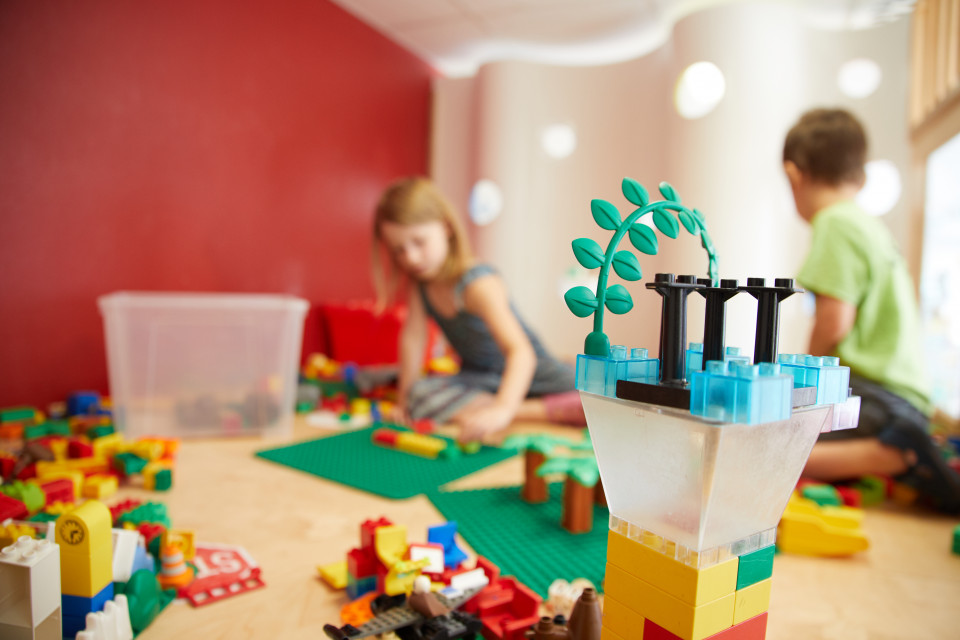
The BIKO results are also an important source of information when it comes to the question of early school enrollment for so-called KANN children. As elementary educational institutions, daycare centers, including Die Wichtel, are obliged to inform parents annually about their child's developmental progress. Therefore, the BIKO educational documentation, together with observations from everyday life and continuous exchange within the team, forms the basis for the parent-teacher conference.