
Additional offers
Start from 2
The "Start from 2" program is an educational and prevention program that specifically aims to promote social-emotional skills integrated into everyday life
for 2- and 3-year-old children in daycare centers. It was developed by the German League for the Child. The program is divided into four main aspects and offers a total of eight subject areas, which are described in a so-called "logbook".
for 2- and 3-year-old children in daycare centers. It was developed by the German League for the Child. The program is divided into four main aspects and offers a total of eight subject areas, which are described in a so-called "logbook".
The four main aspects of the program are
- Physical and mental well-being
- Perception
- Emotional skills
- Social skills
These main aspects include the following subject areas:
- I feel comfortable
- Me in the daycare center
- My senses
- What touches me
- My feelings
- Emotion words
- We together
- My family
The program offers suggestions for interactions, group activities and room design. Materials that are used to implement the program are stored in a blue bag. These include, for example, wooden figures or emotion cards from Tula and Tim as well as a CD with children's songs about emotions.
Activities on the various topics are carried out regularly in small groups.
The program is continued in the kindergarten under the name "KigaPlus".
Activities on the various topics are carried out regularly in small groups.
The program is continued in the kindergarten under the name "KigaPlus".
Kindergarten Plus
Kindergarten Plus is a program of the "German League of the Child" and comprises ten modules. Each module lasts around 60-90 minutes, in which the children in the Red and Green kindergarten groups can take part in small groups. The various modules take place at weekly intervals. The program starts with the body, which is familiar to the children, and then moves on to the more abstract emotions.
Sensorimotor skills
Module 1: My body and me
Module 2: My senses and me
Module 2: My senses and me
Emotional skills
Module 3: Me and my feelings
Module 4: Me, my fear and my courage
Module 5: Me, my anger and my joy
Module 6: Me, my sadness and my happiness
Module 4: Me, my fear and my courage
Module 5: Me, my anger and my joy
Module 6: Me, my sadness and my happiness
Social skills
Module 7: You and me
Module 8: Me and my space
Module 8: Me and my space
Learning methodological skills
Module 9: What I take with me
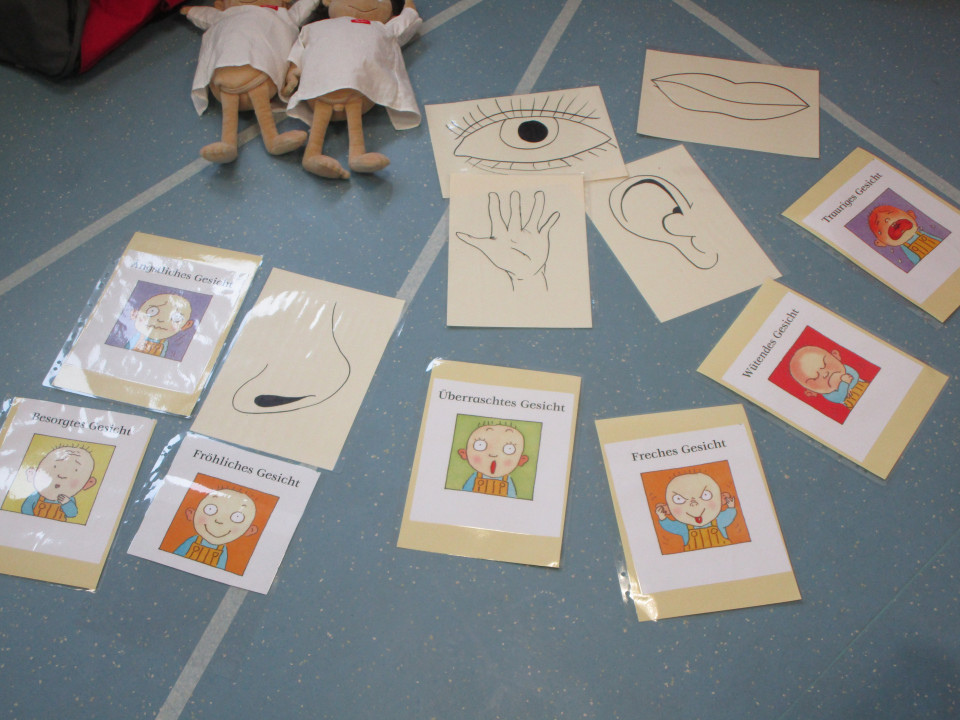
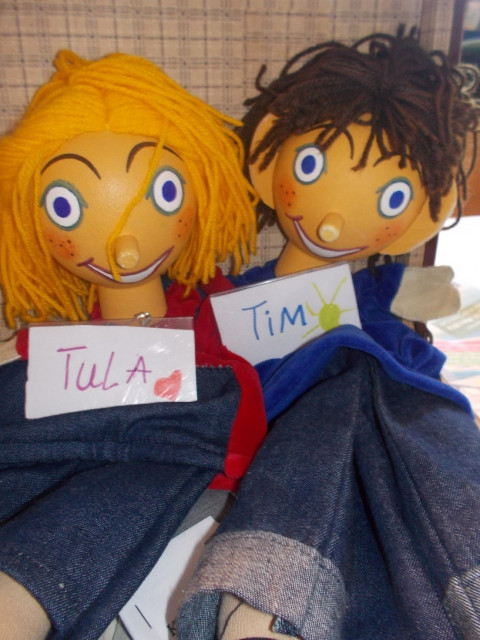
The program is aimed at all four to six-year-old children, as children of this age already have a certain amount of emotional knowledge. It is continuously accompanied by the hand puppets "Tula" and "Tim". Each module of the program begins and ends with the song "Tula and Tim". At the end of each module, each child receives an emotional pearl in the form of a necklace or key ring.
Ideally, the program is carried out by a pedagogical specialist who not only takes the lead, but is also responsible for observing and documenting the children's progress.
The goals of the program are diverse. It aims to strengthen the personality of four to five-year-old children and to promote their perception of themselves and others. The children's empathy is increased, as are their communication and conflict resolution skills. Another aim is to improve the perception of self-efficacy and self-competence, as well as to promote motivation and performance. In addition, the children's relationship skills are also developed.
At the end of the program, each child receives an individual educational and learning story as well as their emotional chain, which has grown over the course of the program. In addition, Tula and Tim make a brief appearance at the first day of school sleepover to give the children an unforgettable finale.
Wundertütenzeit
The pre-school years are an important phase in a child's development. Through targeted activities and exercises, the children are prepared for the demands of elementary school in a playful and holistic way. Our educational concept aims to strengthen the children in all relevant areas of development in order to give them a good start at elementary school. This not only strengthens cognitive and social skills, but also the ability to work with concentration and perseverance and to sit quietly and attentively at the table.
The preschool program in our daycare center is diverse and includes various activities and learning areas that are coordinated with each other so that the children can develop their abilities into skills.
In addition to learning letters through play, we play word games, recognize rhymes, clap syllables and tell stories to strengthen language skills. By talking about factual topics, the vocabulary is expanded and further precursor skills such as recognizing sounds are acquired. In order to prepare the children for formal arithmetic, they are taught the basics of mathematics such as playful counting, sorting and recognizing patterns and shapes. The children's understanding of quantities is encouraged, for example, by having to hand out work materials for all the children. With a small counting rally through the daycare center, the children are constantly discovering new corners for themselves. On excursions, they also discover that letters appear in traffic and numbers appear on buses and trains or to what extent they are relevant for shopping.
Another important aspect of the preschool years is the development of concentration and perseverance. These skills are essential in order to meet the demands of school learning, which requires longer periods of attention and perseverance. To this end, the duration of the activities is increased over time in order to slowly build up the children's stamina.
In addition to cognitive skills, however, the children also learn social and emotional skills, which are most important for the transition so that the child can adequately express their needs and make connections. By working in small groups across two groups, the children learn how to interact with others, resolve conflicts and work together in groups. This is important in order to find their way around a class group at school. Joint projects and group work promote the children's communication skills and cooperation.
At the same time, the children practise recognizing their own feelings and those of others and reacting appropriately to them. They develop self-confidence and independence. The professionals accompany the children individually, as each child reacts differently to the transition, some are unsettled by the uncertainty of the situation, others are full of anticipation and can't wait to leave the "old" daycare center and learn something new.
In order to make the transition as smooth as possible, the daycare center cooperates with various nearby elementary school such as the Tiefburg and Heiligenberg schools and the English Institute elementary school so that the children can visit at least one, perhaps even their future elementary school, get to know their new surroundings and make their first contacts.
As the children spend a lot of time sitting at the table at school, it is important to get them used to this situation in kindergarten. To this end, we play table games, work on worksheets and specifically train the children in their fine motor development. Correct pencil posture, which is playfully strengthened through a pirate course, also includes correct ergonomic sitting on the chair and correct arm posture to avoid pain or tiredness.
Another important aspect of the preschool years is learning how to keep a notebook. This is why every child receives their own exercise book at the beginning of the "Wundertütenzeit", as the Wichtel preschool program is called. Playful writing and drawing exercises help the children to get used to using exercise books. The children also learn how to keep their exercise books tidy, turn pages correctly and work neatly. Creative tasks in which the children can design and decorate their exercise books encourage them to enjoy using exercise books.
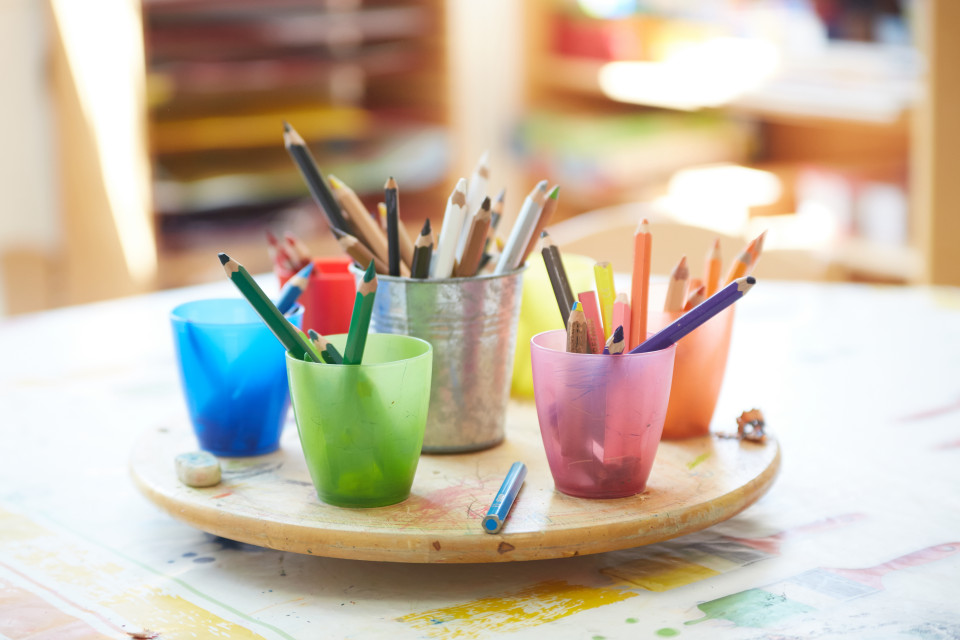
Work materials such as pens, scissors and glue are shared to encourage sharing and cooperation.
The children develop an understanding of consideration and fairness in dealing with others by learning to distribute and share materials fairly. By sharing materials, the children learn to take responsibility and treat the items with care.
On the last parents' evening in the fall before the children start school, parents are given a presentation on everything they need to know about the preschool year. Parents are also involved in the transition process by being invited to the daycare center to make school bags together. Parents and family members are invited to the school farewell party, which takes place in the summer, to celebrate the end of the kindergarten phase of life and the beginning of the school phase of life together.
The children develop an understanding of consideration and fairness in dealing with others by learning to distribute and share materials fairly. By sharing materials, the children learn to take responsibility and treat the items with care.
On the last parents' evening in the fall before the children start school, parents are given a presentation on everything they need to know about the preschool year. Parents are also involved in the transition process by being invited to the daycare center to make school bags together. Parents and family members are invited to the school farewell party, which takes place in the summer, to celebrate the end of the kindergarten phase of life and the beginning of the school phase of life together.
{CONCEPT_NAVI}