
Individualized support
"It is normal to be different. There is no standard for being human. Some people are blind or deaf, others have learning difficulties, a mental or physical disability - but there are also people without a sense of humor, eternal pessimists. (...) That disability is only understood as diversity is a goal that we must all strive for." (Richard von Weizäcker in 1993)
When dealing with children, it is important for us to address the strengths and resources that each of them has, as well as the ways in which children are alike, similar or different from one another: In appearance, in abilities, in preferences and much more. We provide child-friendly materials (such as appropriate picture books and games) for this purpose.
Children quickly notice when playmates behave "differently" to how they have previously experienced them. To ensure that this perception does not turn into judgmental categories ("xy is normal, xyz is weird"), children need explanations as to WHY, for example, a child with trisomy 21 cannot yet speak so clearly. We do this in child-friendly terms as soon as children make such observations on their own initiative. Enlightening words from the educators lead to knowledge and thus to the removal of taboos about difference and diversity. This should prevent the exclusion of other people on the basis of a perceived "he behaves differently than me and differently than I have experienced so far" and promote a general openness towards all people. In this way, children can grow up without fear of "being different".
Although the UN Convention on the Rights of Persons with Disabilities has been in force in Germany since 2009 and therefore everyone (regardless of whether they are disabled or not) has the right to an equal life in society, unfortunately there is often still a struggle for financial support, especially if a child with special needs is to be given the best possible support at nursery. This requires particularly motivated staff who are willing to get involved in previously unknown specialist areas (e.g. sign-supported communication, special features in the context of a metabolic disorder, etc.), as well as a coordinating specialist who has a particularly trained view of child development and supports their colleagues in their daily work with all children.
Since 2012, our facility has had an inclusion officer (qualified psychologist) who specifically supports children with special needs. This is - at least partially - financed by an application for inclusion support https://www.heidelberg.de/hd/-/Verfahrensbeschreibung/eingliederungshilfe-fuer-menschen-mit-behinderungen-beantragen/vbid1179, which parents of a child with special needs can submit to the city of Heidelberg. In close cooperation with the parents, the group teachers and the provider, the inclusion officer develops individual materials and strategies to support the child in everyday life and ensure their participation in the group's daily routine.
Below are some examples of creative, individual solutions that have emerged from this cooperation and have proven successful since 2010 (names of children changed):
Children quickly notice when playmates behave "differently" to how they have previously experienced them. To ensure that this perception does not turn into judgmental categories ("xy is normal, xyz is weird"), children need explanations as to WHY, for example, a child with trisomy 21 cannot yet speak so clearly. We do this in child-friendly terms as soon as children make such observations on their own initiative. Enlightening words from the educators lead to knowledge and thus to the removal of taboos about difference and diversity. This should prevent the exclusion of other people on the basis of a perceived "he behaves differently than me and differently than I have experienced so far" and promote a general openness towards all people. In this way, children can grow up without fear of "being different".
Although the UN Convention on the Rights of Persons with Disabilities has been in force in Germany since 2009 and therefore everyone (regardless of whether they are disabled or not) has the right to an equal life in society, unfortunately there is often still a struggle for financial support, especially if a child with special needs is to be given the best possible support at nursery. This requires particularly motivated staff who are willing to get involved in previously unknown specialist areas (e.g. sign-supported communication, special features in the context of a metabolic disorder, etc.), as well as a coordinating specialist who has a particularly trained view of child development and supports their colleagues in their daily work with all children.
Since 2012, our facility has had an inclusion officer (qualified psychologist) who specifically supports children with special needs. This is - at least partially - financed by an application for inclusion support https://www.heidelberg.de/hd/-/Verfahrensbeschreibung/eingliederungshilfe-fuer-menschen-mit-behinderungen-beantragen/vbid1179, which parents of a child with special needs can submit to the city of Heidelberg. In close cooperation with the parents, the group teachers and the provider, the inclusion officer develops individual materials and strategies to support the child in everyday life and ensure their participation in the group's daily routine.
Below are some examples of creative, individual solutions that have emerged from this cooperation and have proven successful since 2010 (names of children changed):
Noahmobil
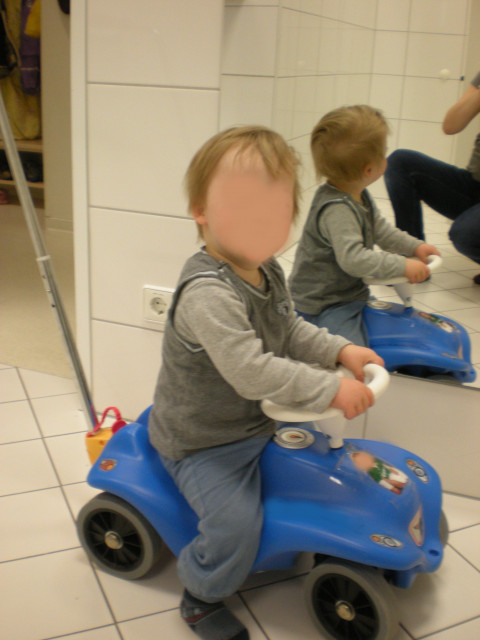
Noah (trisomy 21) was not yet able to walk at just under 2 years of age, but was slowly becoming too heavy for the teachers to carry on the way to the bathroom or the gym to change his nappy. A bobby car with a push bar was therefore purchased so that Noah could be pushed around the daycare center during transitions. A photo of Noah marked the bobby car for the other children as his personal "Noahmobile". For the times when the Bobbycar was not in use, there were parking spaces marked with tape on the floor of the daycare center in front of the gym, in front of the group room and in the children's bathroom. It was explained to all the other 87 children in the daycare center in child-friendly words that this Bobbycar is only there for Noah, who needs longer to learn to walk, and that they are not allowed to remove it from the parking spaces. Once Noah had learned to sit upright on the Noahmobile, make pushing motions with his feet and finally walk on his own, the push bar was removed and the Noahmobile joined the other bobbycars in the garden for all the children.
Learning through melodies
Three-year-old Lisa (trisomy 21) had great difficulty learning new movement sequences, but at the same time had an insular talent for music - she knew hundreds of songs by heart. The inclusion officer therefore came up with numerous short melodies for new skills to be learned, which were always sung to fixed sequences of actions by teachers and parents. After a short time, Lisa was singing along to these melodies and soon learned how to put on and take off her shoes, use the soap dispenser, wait or eat with a fork.
Max Street
Due to cerebral palsy, Max (3 years old) had problems keeping his balance when walking if he was accidentally bumped into by other children. For a long time, he therefore did not dare to run around freely in the group room and change play areas for fear of falling. He was very interested in cars and traffic. A "Max street" was therefore permanently taped to the floor in the group room, where all the children were allowed to walk. Max, however, had "right of way" over other children. With this "traffic rule" in mind, he soon dared to visit the various play areas in the group room on his own, even without a teacher by his side.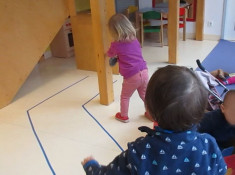
Hand parking
Max (5 years, cerebral palsy) found it difficult to use only one hand when eating and not both hands, e.g. to eat yogurt. As he was very interested in everything to do with road traffic, he was given a "hand parking space": On a place mat, parking spaces were marked with "P" for both hands to the left and right of the plate. From then on, he always placed the unused hand in its "parking space" and thus learned to eat with one hand. Other children, who sometimes also found it difficult not to eat with both hands, adopted this scheme and also placed their hands - even at home - on imaginary parking spaces.
Who eats what and why?
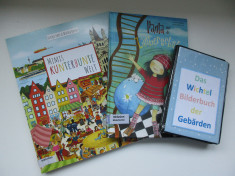
Jelena (3 years old) had a congenital metabolic disorder and developmental delay. She had to eat calculated amounts of selected foods every day to prevent her body from going into toxic shock. It was difficult for her to understand why she was not allowed to eat eggs or cheese, for example, but other children were. The inclusion officer therefore created a picture book for her group: "Who eats what and why?". It explained in simple, child-friendly terms what different animals eat, what humans need and how food is converted into muscle power. The fictional protagonist Anton in the photo book was also only allowed to eat a defined amount of certain foods and - like Jelena - had a PEG tube through his abdominal wall. This book created opportunities for discussion between the children about the role of food and bodily functions.
Furnishings
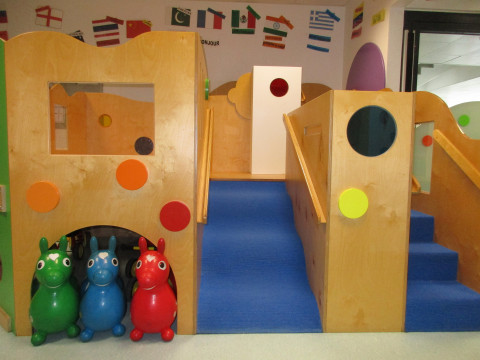
◦ Liam (2 years) was muscle hypotonic due to his Down syndrome. To make it easier for him to sit in a chair, his talented grandparents got involved: they built a footrest into one of our children's chairs so that Liam always had contact with the floor when sitting, which gave him more body stability. As soon as Liam's legs were long enough for his feet to reach the floor, the footrest was removed again.◦ When renovating all the raised play levels in the daycare center's group rooms in recent years, care was taken to ensure that they are also easy to reach and climb on for children with special needs, that they can be seen particularly well from the outside or below and that there is no risk of hypermobility (e.g. extreme mobility due to trisomy 21) due to children climbing over or getting trapped.
In addition to individual support, the inclusion officer also advises the daycare groups on a wide range of developmental psychological issues and coordinates exchanges with specialists such as speech therapists, social pediatric centers or counselling services.
Our multi-professional, interdisciplinary team is characterized by a very high level of commitment to each individual child. We aim to overcome challenges in the best possible way and always find individual solutions.
Living diversity is one of the key experiences that is fundamental for today's children to lead their lives in the globalized world of tomorrow.
If a disabled child requires individual support over and above the general support provided in kindergarten, parents of a child with a mental or physical disability can apply for integration assistance from the responsible local social welfare office. Parents of a child with a so-called "mental disability" (this includes ADHD, for example) apply for integration assistance from the responsible local youth welfare office. The responsible social welfare or youth welfare office draws up an overall plan with the involvement of the health department, the early intervention center and the assessment of the daycare center and approves the form of integration assistance. As a rule, it is reviewed every year whether a child still requires integration assistance.
{INCLUSION_NAVI}